- Client
- Fernwood Community School of the Arts
- Year
- 2024
- Role
- Product designer and front-end prototyper
- Team
- Ines Alvarez, program coordinator
- Dev Patel, engineer
- Mina Okafor, design and front end
The brief
Fernwood runs 320 after-school and weekend classes a week in 14 rooms, taught by 60 part-time teachers. Building each term took Ines Alvarez, the program coordinator, about three weeks in a shared spreadsheet. Every change cascaded, teacher availability lived in her inbox, and double-bookings turned up on the first day of term: 11 of them in spring 2023.
The constraint
Ines had to be able to override anything, so the solver could suggest but never decide. A class with enrolled families could never move without those families knowing. Fernwood has one engineer, Dev Patel, so it had to run on their existing Postgres with a solver small enough for him to own. And the spreadsheet had to keep working until people trusted the new thing.
Decisions
- 1
Show the solver’s work
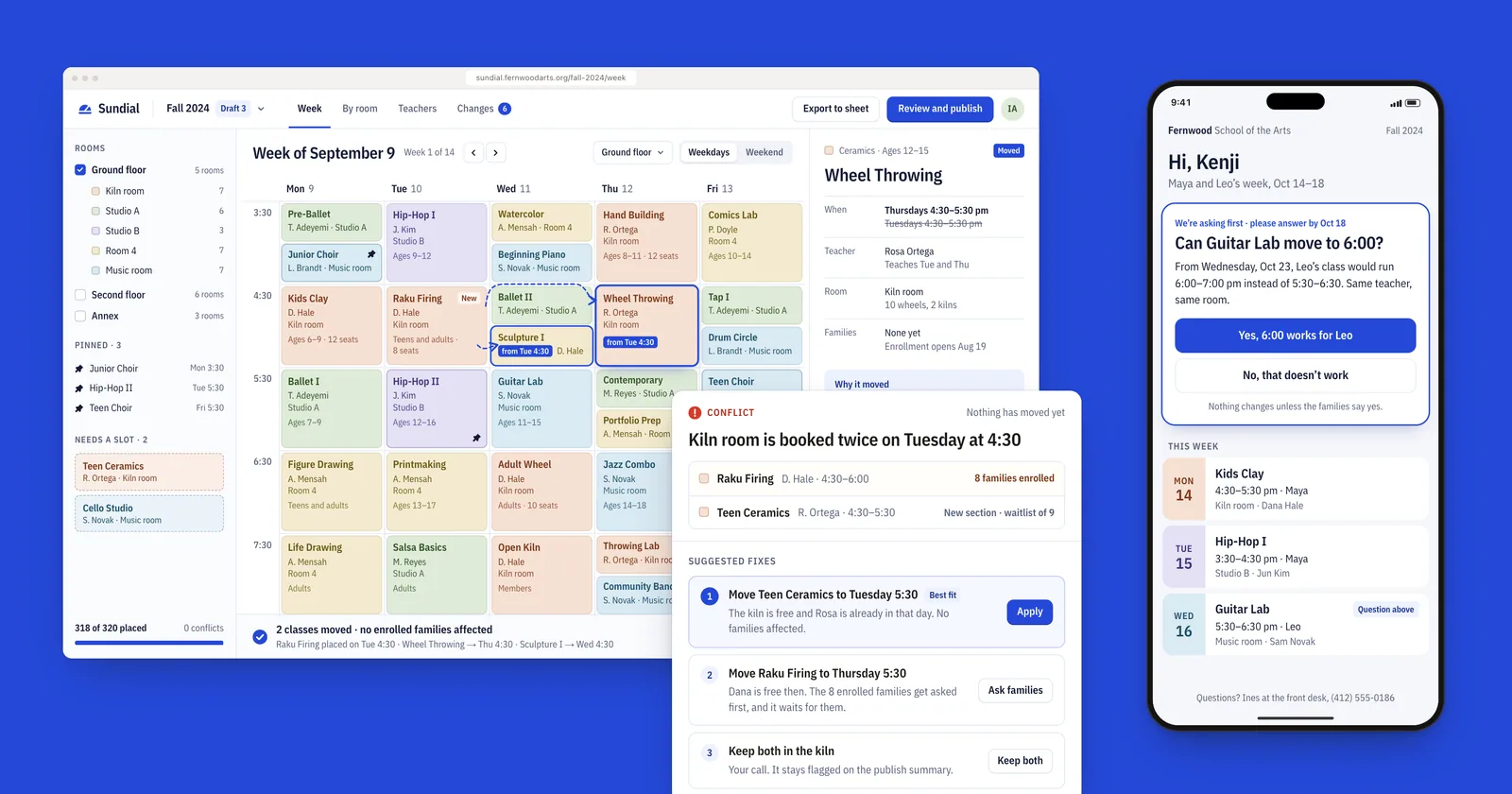
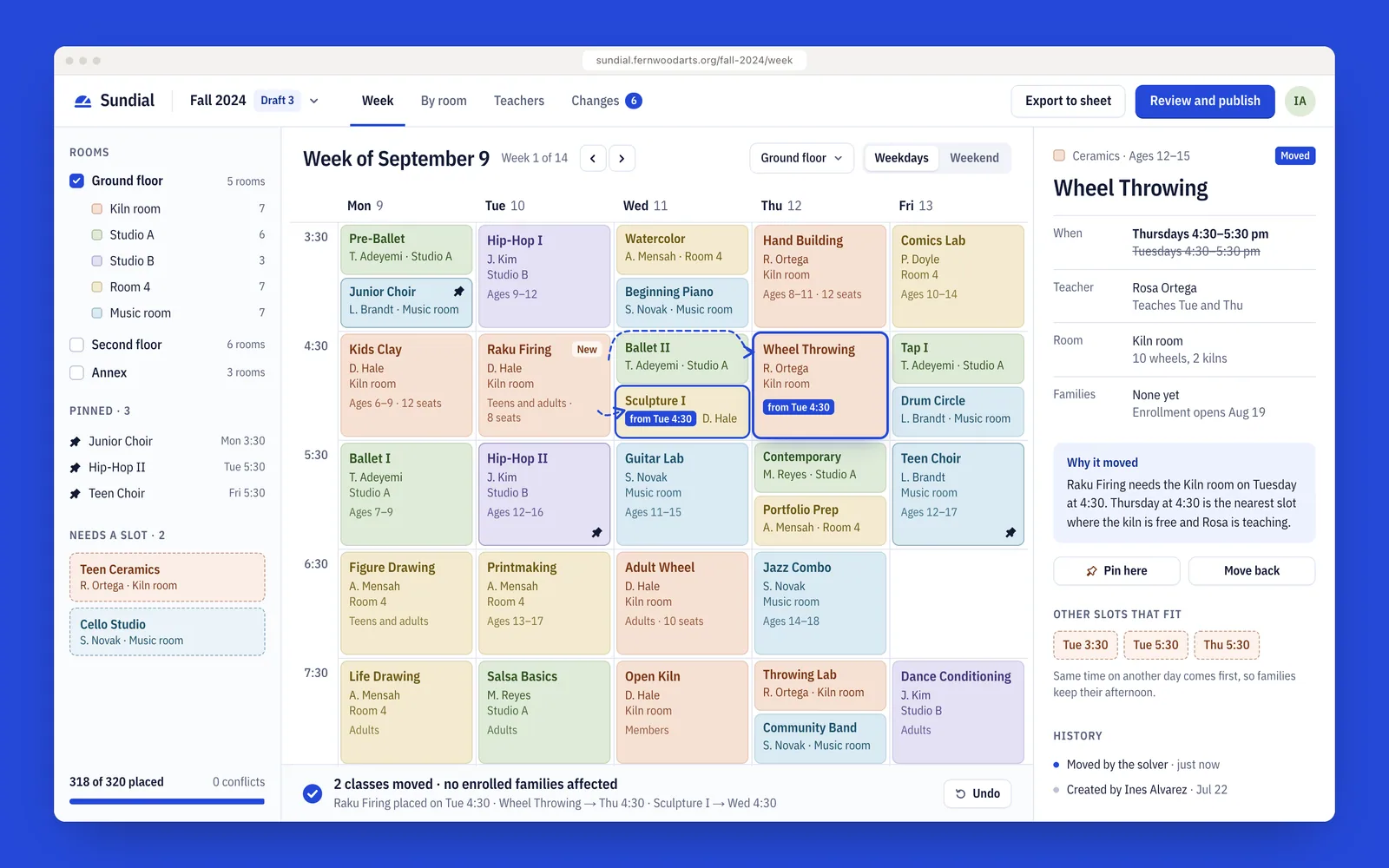
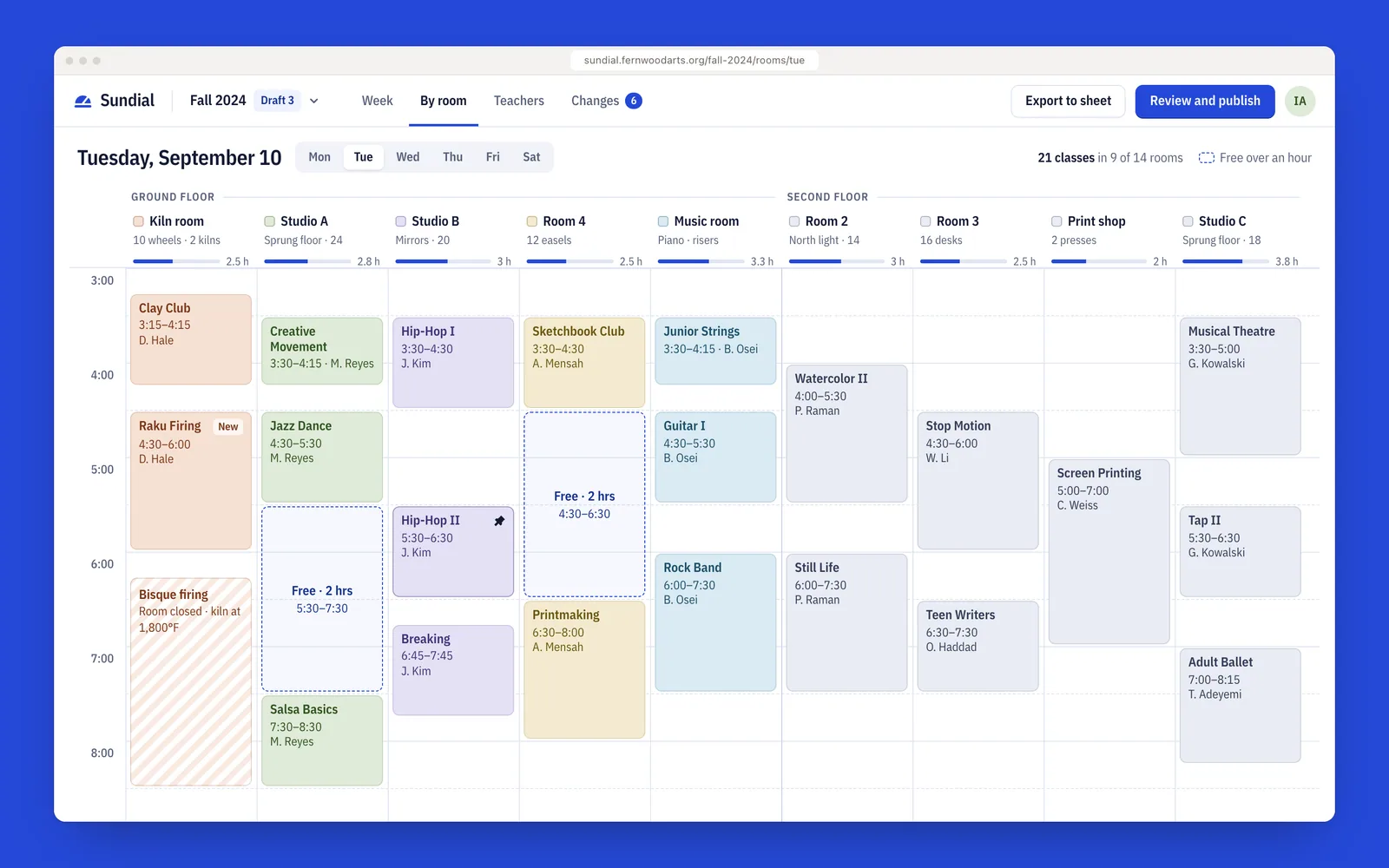
In the first prototype the solver recomputed the week and redrew it. Ines couldn’t see what had changed, so she rechecked everything, which was the job we were trying to remove. Now a moved class glides from its old slot to its new one, the status line names every move, and the class panel says why it moved.
- 2
Pins, not settings
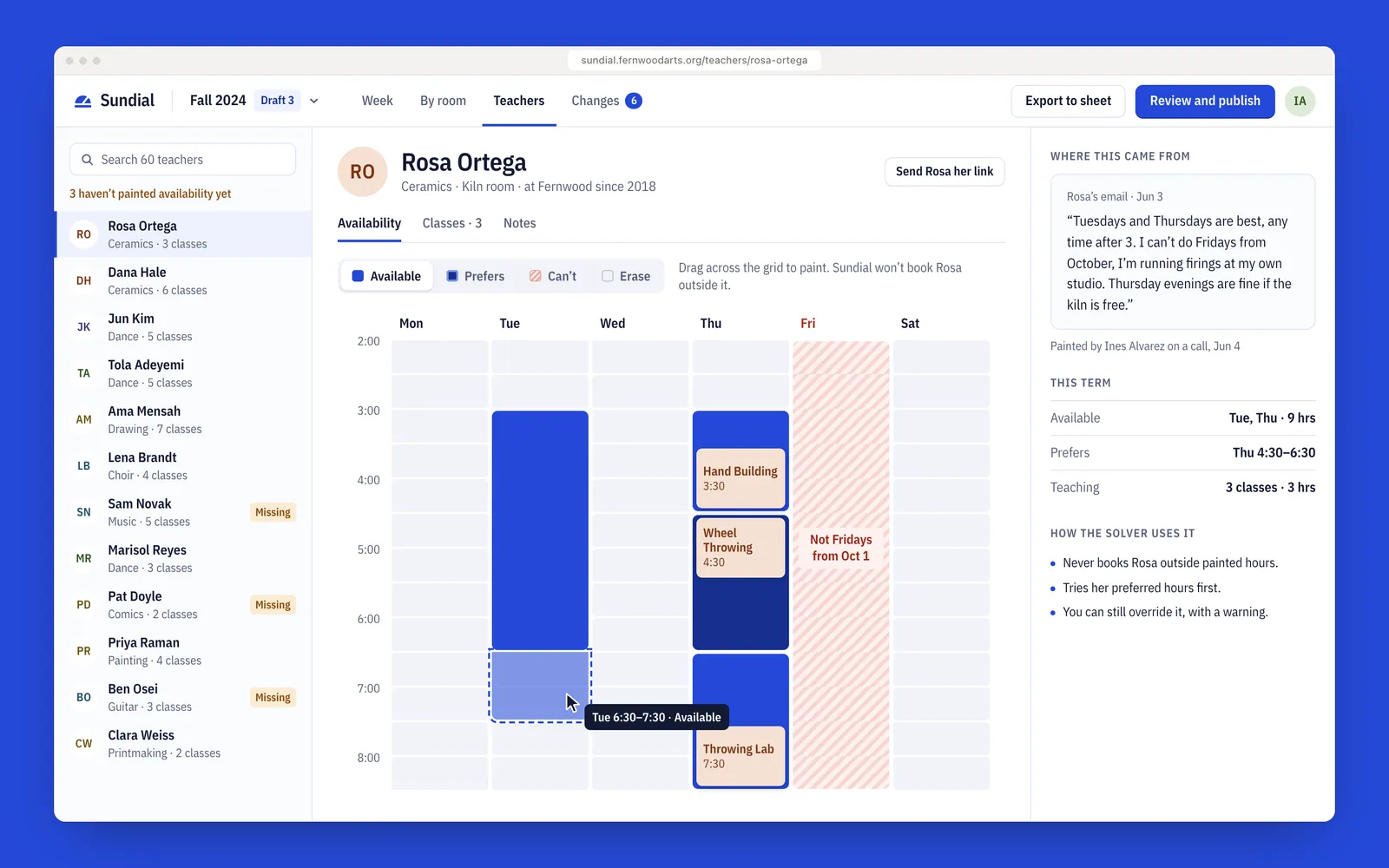
I started with a constraints form: room rules, teacher rules, priorities. Nobody filled it in, because nobody thinks about a term that way. Instead you pin a class to lock it where it is, and the solver routes around pins. Teacher availability is painted on a grid, not typed into fields.
- 3
Conflicts in plain words
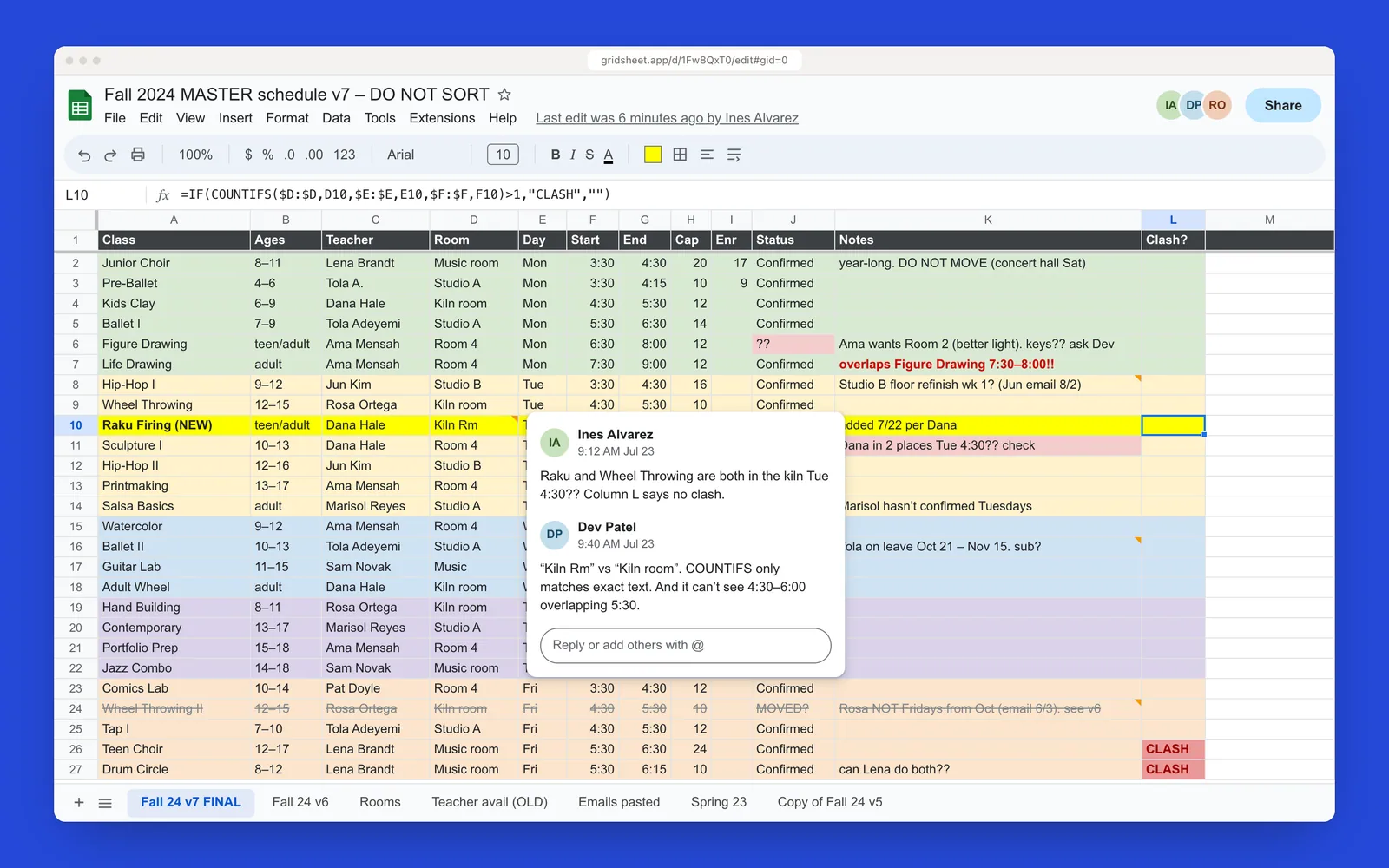
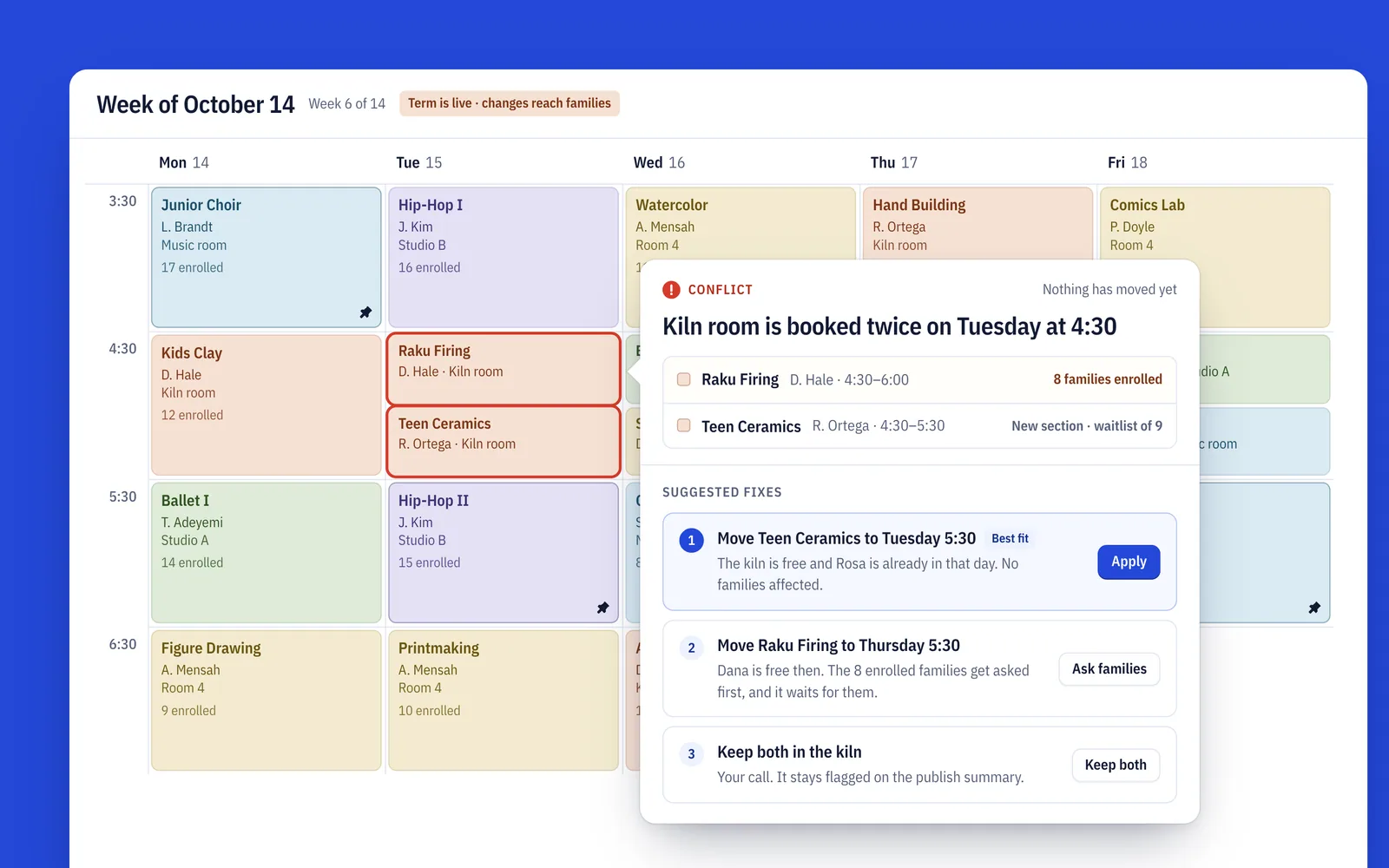
The spreadsheet said CLASH in red, when its formula caught the clash at all. Sundial says “Kiln room is booked twice on Tuesday at 4:30,” names both classes, and offers fixes ranked by how many people they touch. Keeping both is always one of the options, because sometimes Ines knows something the solver doesn’t.
- 4
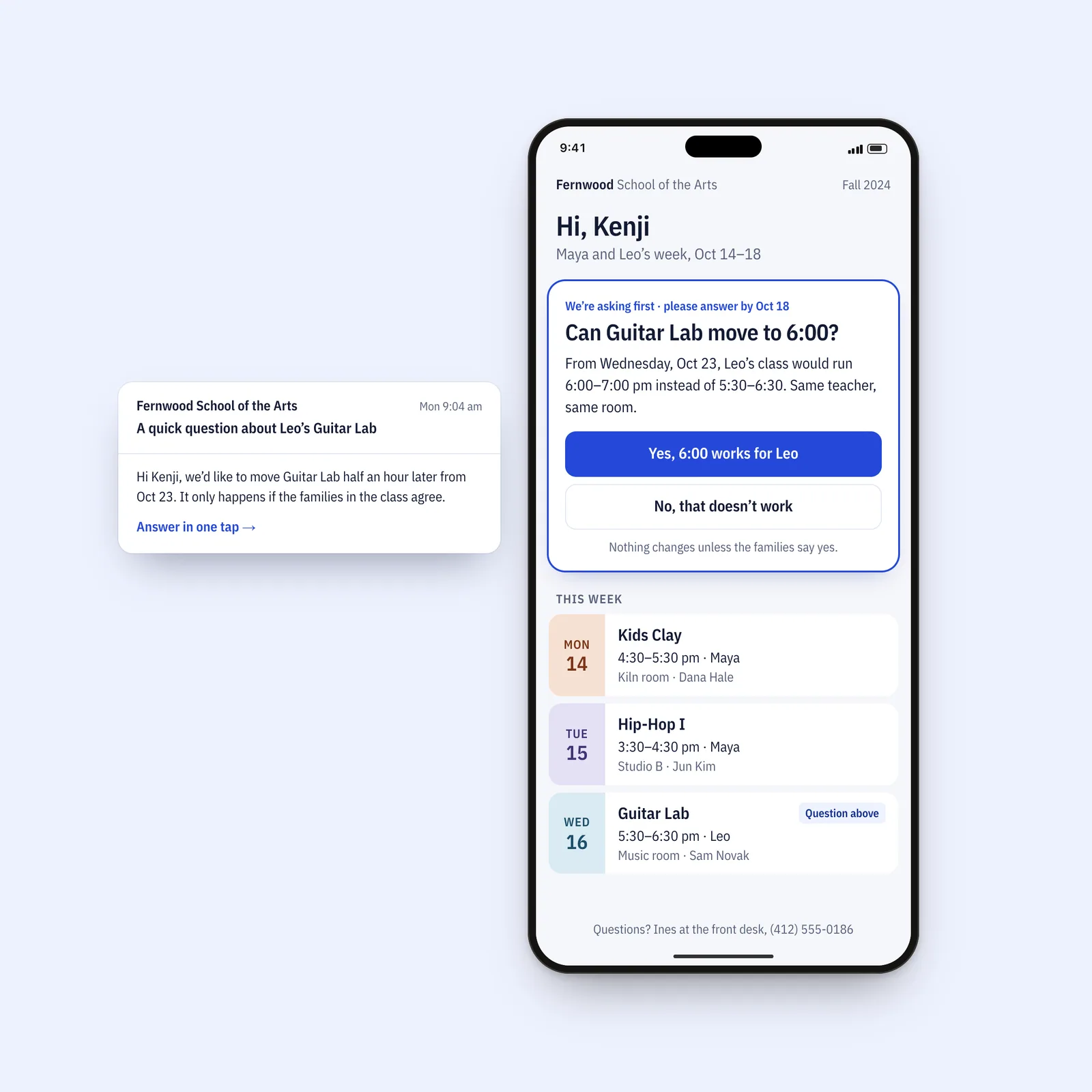
Enrolled classes ask first
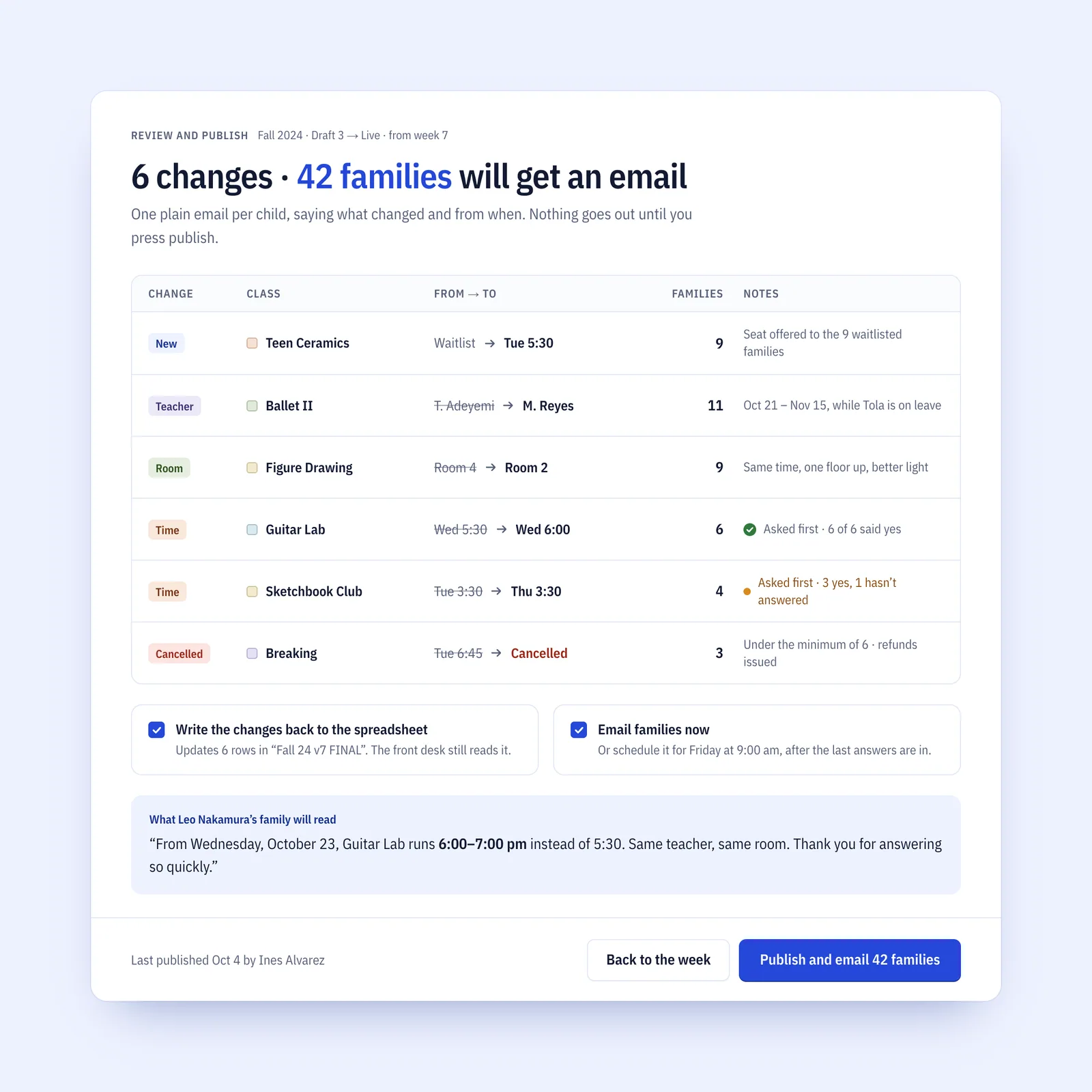
Once a term is live, a move that touches enrolled families is held as a proposal that shows how many families it affects. Sundial asks them in one short email and waits for answers. Only then does the change reach the publish summary, which also writes it back to the spreadsheet the front desk still reads.
2 classes moved · no enrolled families affected
Wheel Throwing → Thu 4:30 · Sculpture I → Wed 4:30
Two weeks at the front desk
I sat with Ines while she built the summer session. The spreadsheet wasn’t really the problem. It was the only place the whole term existed, and seven versions of it lived in the same file because nobody dared delete one.
Most of her time went to checking what a change had broken. Moving one ceramics class meant re-reading the kiln, the teacher’s emails, and every class that shared either. The tool had to do that checking, and then show her that it had.
I also tried the obvious thing first: a solver that generated the whole term at once. Ines looked at the result and said she’d have to check all 320 classes anyway. We dropped it that afternoon and built something that makes one small move at a time.
“The spreadsheet never told me what I’d broken. Sundial shows me, and it asks before it touches anybody’s Tuesday.”
Built to be owned by one engineer
I prototyped the week view in React against a copy of Fernwood’s Postgres, so Dev could see real queries from the first week. The solver is a few hundred lines with four rules: a room can’t double-book, a teacher can’t be in two places, painted availability is a hard edge, and pins never move.
When something has to move, it looks for the nearest slot, same time on another day first, so families keep their afternoon. We tried a scoring model for family-friendly times and dropped it, because nobody, including me, could explain its choices to Ines.
Outcome
Ines built the fall 2024 term in four days instead of three weeks, and the first day of term had no double-bookings. Mid-term change requests mostly close the same day. By week two the coordinators had stopped opening the spreadsheet, though it still updates every time they publish.
- to build the fall term, down from about three weeks
- 4 daysto build the fall term, down from about three weeksInes’s own log, first draft to published schedule, spring 2024 against fall 2024.
- double-bookings on the first day, down from 11
- 0double-bookings on the first day, down from 11Counted by the front desk on day one of spring 2023 and fall 2024.
- of mid-term change requests resolved the same day
- 89%of mid-term change requests resolved the same day142 requests in fall 2024, measured from request to published change.
- when coordinators stopped opening the spreadsheet
- Week 2when coordinators stopped opening the spreadsheetFrom the sheet’s edit history. Sundial still writes back to it on publish.